Venables' paralysis
The Pale HorseVenables' paralysis is a confirmed, enduring disability that shapes how Mr Venables moves through the story and becomes a key test of the evidence against him. Its importance lies in the contrast between what Zachariah Osborne thinks he saw and what medical evidence establishes: Mr Venables uses a wheelchair and has been paralysed for years, making Osborne's identification of him as a man walking after Father Gorman untenable.
Identity and Medical Background
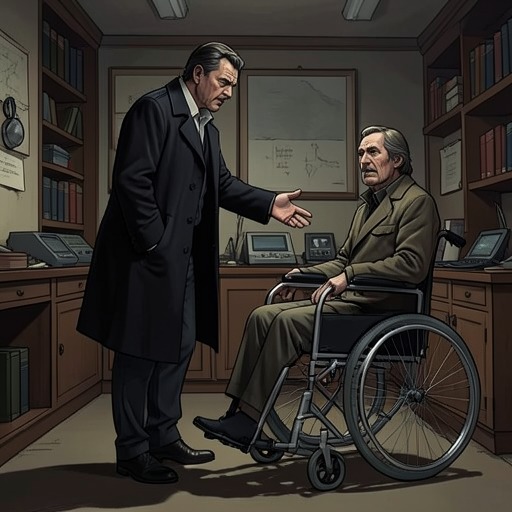
During a conversation with Mark Easterbrook, Mr Venables is described as an invalid whose disability followed polio. He can move about only in a wheelchair. Mark, who had been taken to lunch with him, says the encounter made a powerful impression: he regards Mr Venables as a man of great personality and observes that his disability seems to have heightened his determination to live and enjoy life. The account gives no details of treatment or the circumstances in which he contracted polio; it presents the paralysis as an established condition rather than a temporary setback.
That certainty is made explicit when Mark asks whether Mr Venables could be pretending to be paralysed. Inspector Lejeune answers that the case is as certain as one can be: Sir William Dugdale, Mr Venables' doctor, has assured the police that his limbs are atrophied. The medical confirmation matters because suspicion has attached itself to a supposed sighting of a man walking. In the face of that claim, the condition is not merely a visible impression or an assertion by Mr Venables himself; it has been independently verified by a doctor whom Lejeune regards as above suspicion.
Osborne's Identification and Its Correction
Osborne explains that on the night of the murder he saw Father Gorman pass his establishment at about eight o'clock, with a man following at a short distance. He says the follower's appearance was distinctive enough to attract his attention. Because he makes a habit of remembering customers and their purchases, he presents himself as an observant witness; he had already described the man to the police after the murder.
The identification changes when Osborne sees a wheelchair user at a church fête in the village near his home. He learns that the local resident is Mr Venables and, after a day or two considering the matter, writes to the officer who took his original statement. Inspector Lejeune travels to Bournemouth to hear the new claim, but points out that Mr Venables has been paralysed by polio for years. Lejeune concludes that Osborne must have been misled by a resemblance. The sequence exposes the limit of Osborne's confidence: his memory may be careful, but the supposed match between the man walking and the wheelchair user does not survive comparison with the medical facts.
The paralysis therefore supplies a concrete contradiction, not a general character judgment. It rules out Osborne's identification as Lejeune understands it, but does not by itself explain who followed Father Gorman. The distinction is important in a murder inquiry where suspicion can attach to an impressive or unusual person: evidence about Mr Venables' body corrects one claim without resolving every question surrounding the killing.
How the Disability Shapes Suspicion
The medical fact does not prevent Mr Venables from appearing plausible to those contemplating a private murder organization. Lejeune calls it a pity that Mr Venables is paralysed, adding that, if such an organization exists, he is the kind of man who could plan it. This is a conditional assessment of his capacity and personality, not proof of participation. The scene holds two judgments apart: his physical condition disproves the image of him walking behind Father Gorman, while his perceived intelligence and force of character keep him within the investigators' wider field of suspicion.
Mark's earlier account helps explain that tension. He describes Mr Venables' house, art treasures, and broad range of interests, and remembers a personality strong enough to leave a lasting impression. These details build an image of a cultivated and capable man, but they do not establish guilt. The narrative places that image beside the wheelchair and the medical assurance, resisting the easy equation of physical disability with helplessness while also refusing to treat personal distinction as evidence of crime.
Public Appearance and Narrative Significance
When Inspector Lejeune later brings Mark and the others to see him, Mr Venables receives them with extreme courtesy. He wheels his chair slightly backward to widen the circle around him. Mark notices his distinctive appearance: the movement of his Adam's apple above an old-fashioned collar and his haggard profile with a curved nose. Mr Venables recognizes Mark and remarks, with what Mark reads as faint malice, that he seems to spend a great deal of time in that part of the country. The chair is an ordinary, practical part of his movement in this encounter; it also makes the contrast between Osborne's remembered pedestrian and the actual visitor impossible to overlook.
As a state, Venables' paralysis has a double narrative function. It gives the investigation a firm basis for rejecting a witness's mistaken identification, while leaving room for the separate suspicion that Mr Venables might possess the capacity to organize a crime. The story thus distinguishes disability from culpability: the condition is neither a clue that proves innocence in every respect nor a sign of criminality. It is a specific, medically corroborated fact that forces the characters to revise what they think they saw.